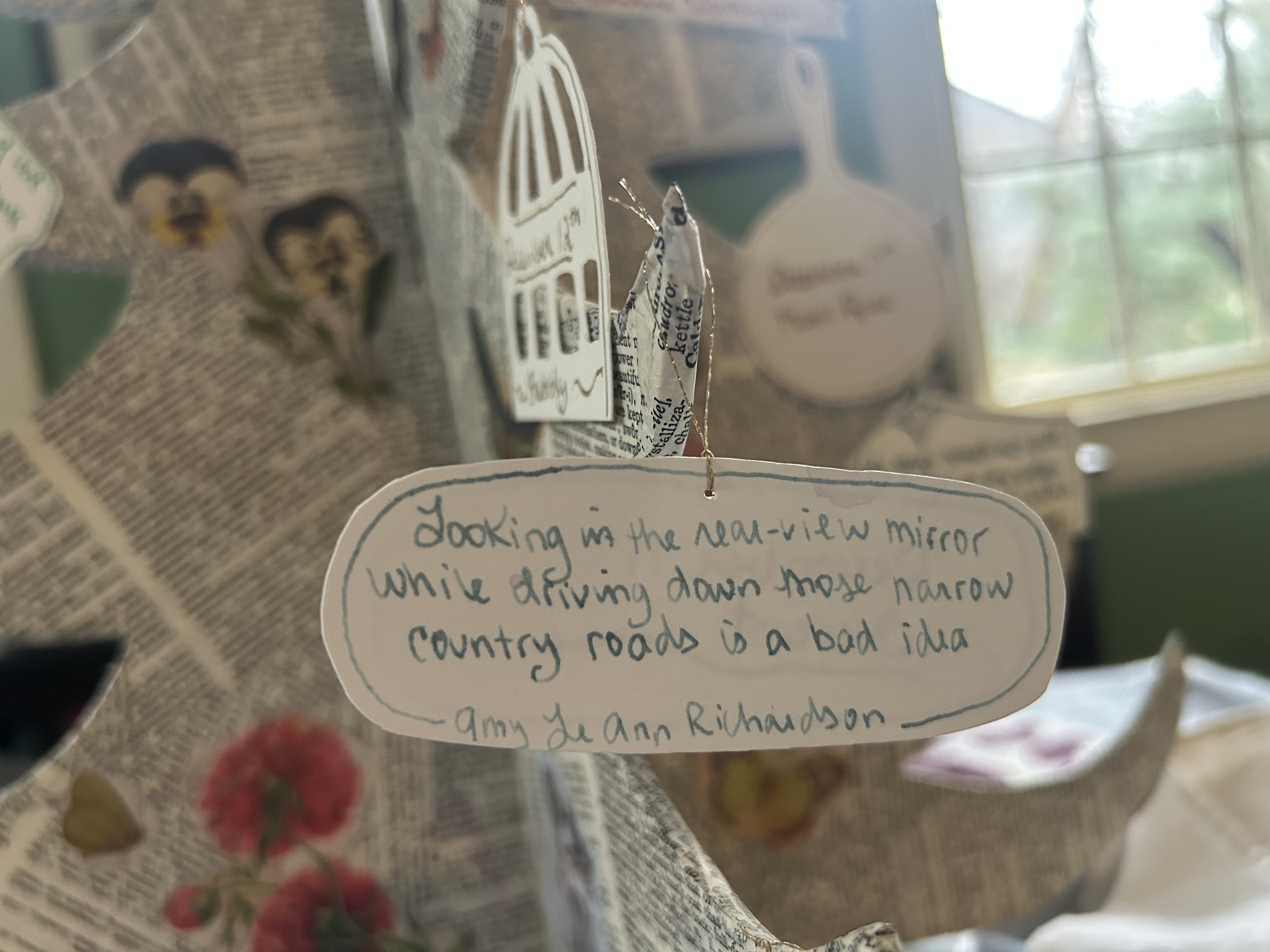
Looking in the rear-view mirror while driving down those narrow country roads is a bad idea.
-Amy Le Ann Richardson, from Don’t Look Back a poem in the Summer 2024 issue of Untelling
Amy Le Ann Richardson is another one of those do-gooders the world is lucky to have. She seems to be everywhere all at once, full of ideas that she is busy putting into motion. She is a writer, a farmer, a visual artist and an advocate for small farmers and the environment, all while raising her young family. One of the cool things she has been up to is hosting writing workshops for mountain women farmers and gardeners through a grant from the Kentucky Foundation for Women to honor and preserve their stories. I’ve spent many hours with her on the porches of Hindman Settlement School in wide-ranging conversations, the kind of talk that spins worlds into being. She doesn’t know this, but I keep the little maple leaf bottle of syrup from her farm she gave me a couple of years ago on my meditation altar. It is there to remind me of the sweetness of friendship.
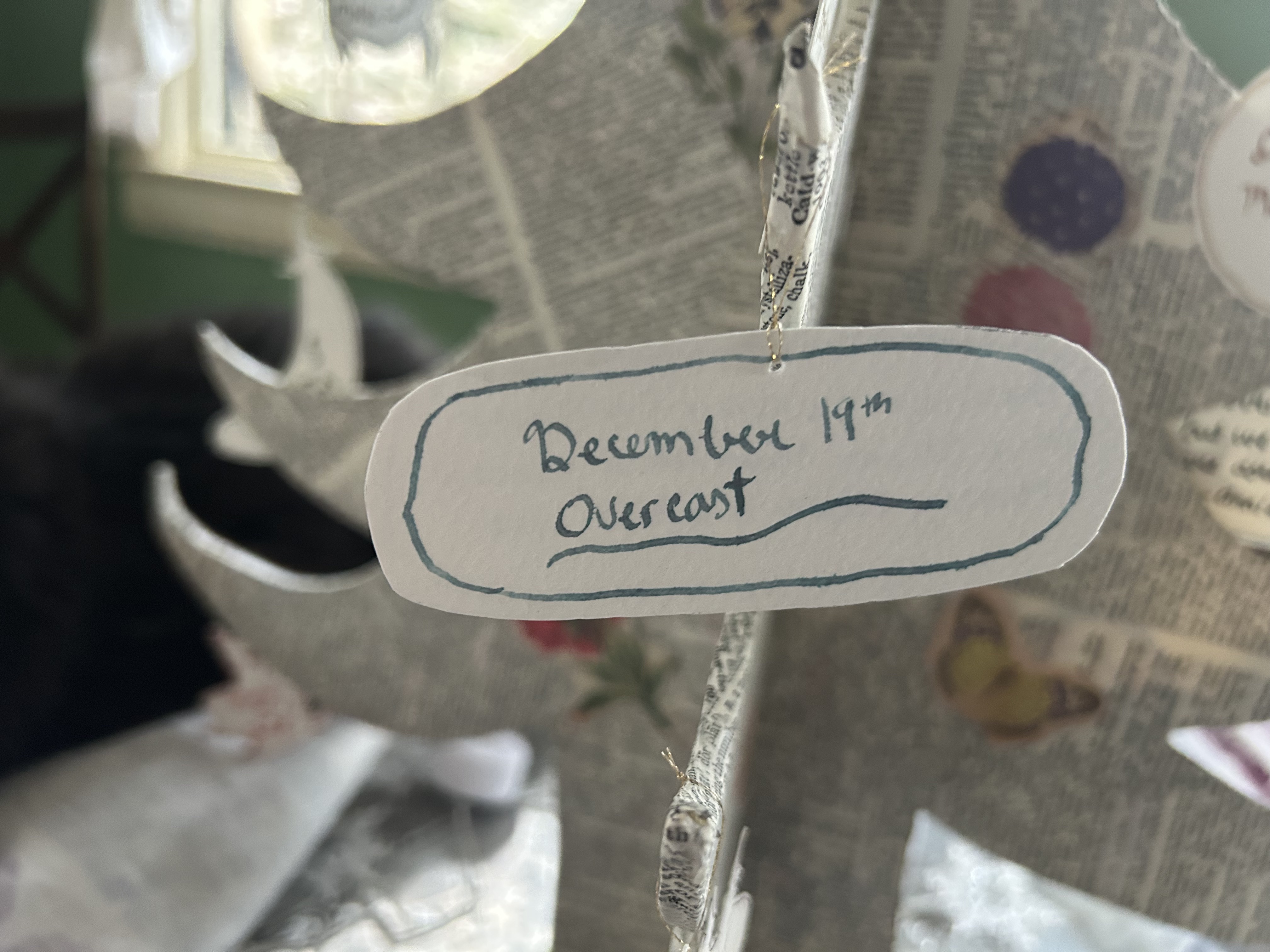
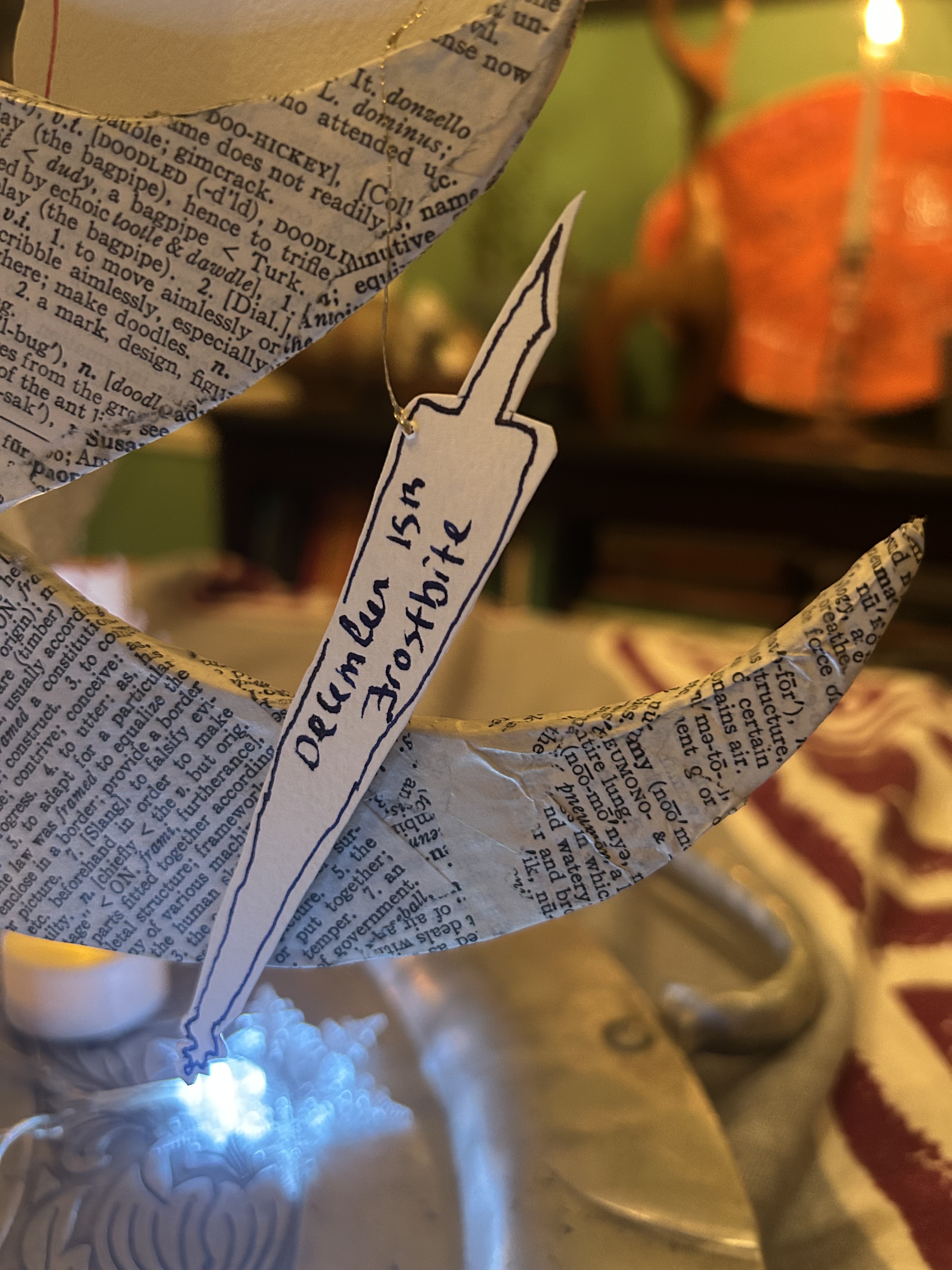
I like overcast days, and I like this Diamine ink. It will be lovely in my writing pen.
My Advent Tree this year is dedicated to my writer friends and teachers. I am so grateful for all the light you shine in the darkness.
An Apology: I am behind on my Advent tree posts, the last week of school before the holiday break has pretty much done me in, but I aim to catch up in the next few days.
-Marianne Worthington from I wanted to write a poem
Marianne Worthington is a wonder. A light many of us have come to depend on at the Appalachian Writers Workshop. Poet, teacher and a friend to everyone but someone who won’t let you off the hook either- do it and do it well. The last couple of years she’s taught a pre-workshop at the AWW open to just 20 or so registrants, first come first serve. As soon as you get your acceptance letter from Hindman, you can sign up. It allows you to come a day early for some writing sessions with special focuses in poetry. I’m no poet, but that doesn’t stop me from writing poems anyway. It helps to have a teacher.
This last summer I was particularly relieved and grateful to be at Hindman for AWW and Marianne’s session. I’d spent the spring in the hospital with my 24 year old daughter who had a cryptogenic stroke that affected her entire right side. It was a terrifying time, but we were helped by so much kindness- from my family, Hindman friends and from my church and school colleagues. Sitting in rehab one day, out of the blue I received a DoorDash gift card from Marianne that made me cry. So thoughtful and so much needed at that moment! By the time Hindman came around, my daughter was in her last week of outpatient rehab and was doing well, though still early in her recovery. My sweet family made it possible for me to go take some deep breaths at Hindman that last week of July.
I hadn’t written anything outside of my journal for months, but it was Marianne’s class that helped create a way in, a door that I could open to begin writing about the stroke. I ended up with a draft of a poem that made me shake inside, so I knew it was truth. It has since become part of a trio of poems called Daughter that will be published in the next issue of Untelling. Thank you, Marianne, for your wisdom and wit and thoughtfulness. Thank you for showing me so many doors.
This is a fabulous red with gold sparkles. Ruby Taffeta by Diamine. Terrific drag name.
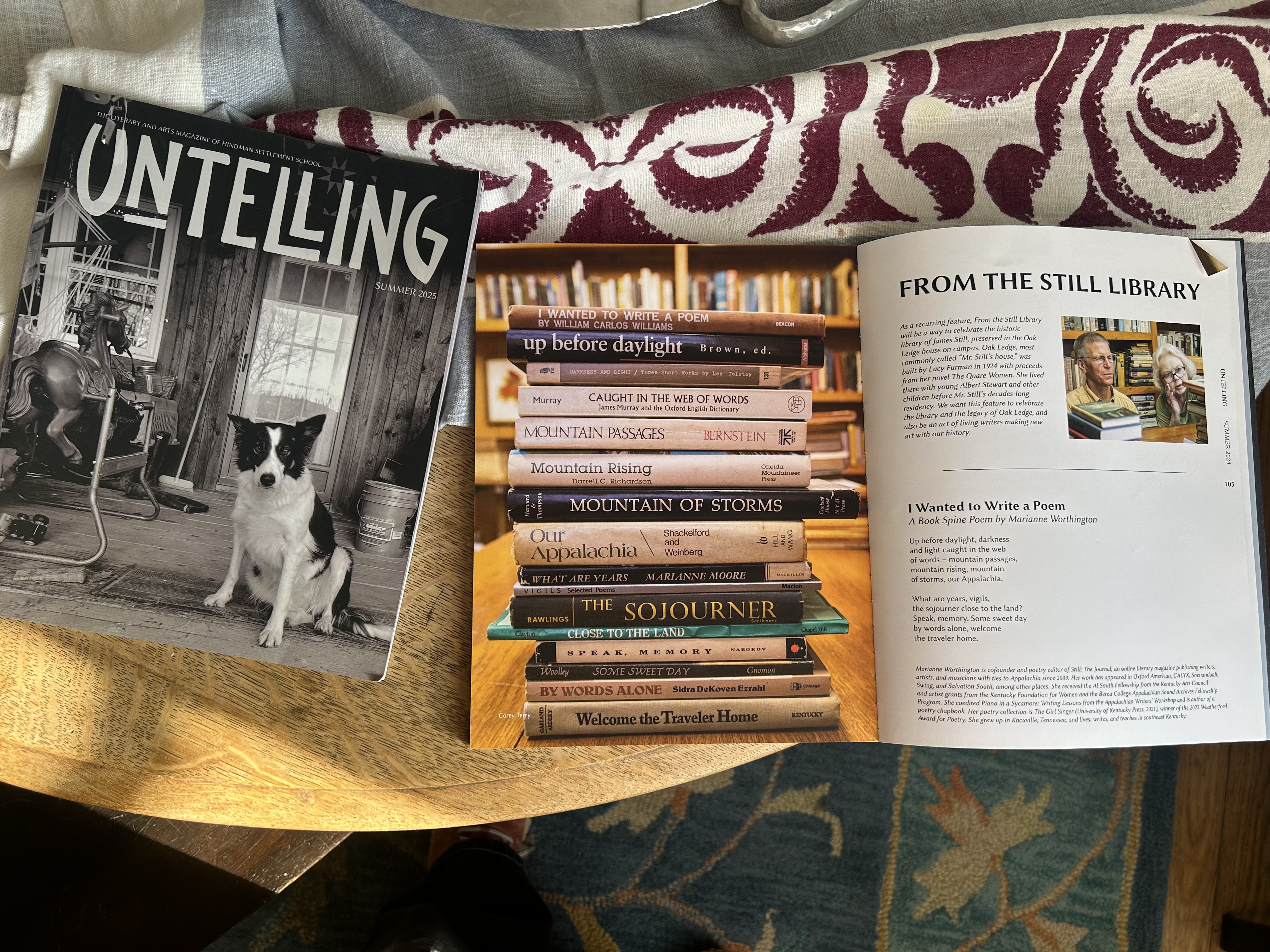
The lines I use in my ornament are from Marianne’s book spine poem in the Summer 2024 issue of Untelling. It’s a feature in every issue in the back pages- different writers are asked to take books from James Still’s office and stack them to make a poem. The photo of the books is by Corey Terry. James Still was a titan of Appalachian literature who lived for many years in Oak Ledge, a house built by Lucy Furman out of the proceeds of TheQuare Women, her book about the remarkable women who founded the Hindman Settlement School. Tickles me pink that you can get this book today, even on Amazon- https://www.amazon.com/Quare-Women-Kentucky-Mountains-Industries/dp/1950564037 though I hope you’ll ask your local bookstore to order it for you instead.
Here is a terrific podcast episode where you can hear Marianne read her work. It’s also a great site for anyone interested in Appalachian literature.
Marianne is a writer, educator and editor. She co-founded Still: The Journal an online journal that energized and celebrated contemporary Appalachian writers. It’s no longer being published but you can still access the archives- it’s a treasure trove and it’s free: https://www.stilljournal.net/
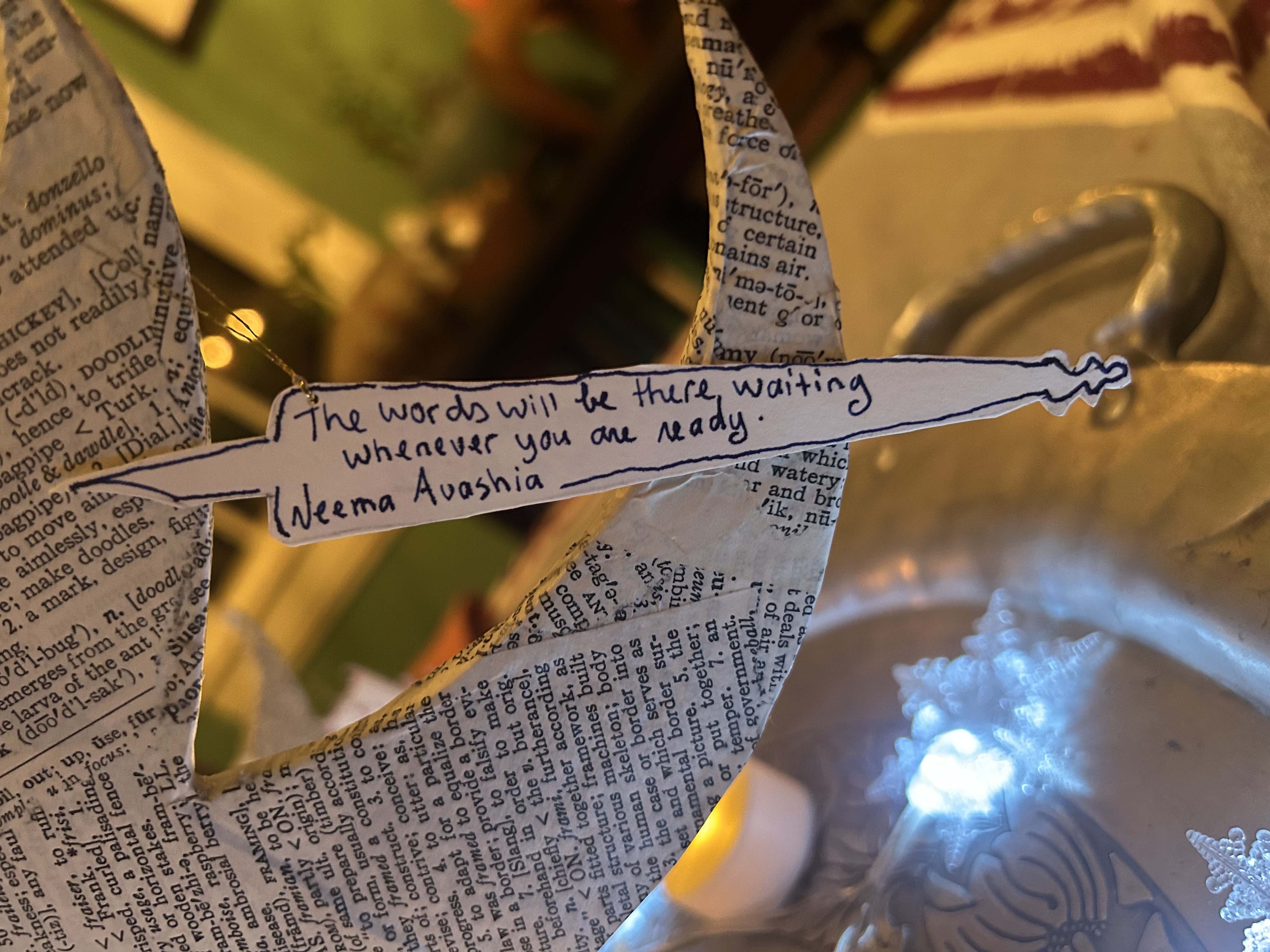
The words will be there waiting whenever you are ready.
-Neema Avashia from Untelling Summer 2025
What a joy to be in Neema Avashia’s writing workshops. She is a master teacher, someone who lights up the room so that you suddenly see all sorts of things you never noticed before. The ink flows, as does the laughter. Like me, she teaches middle school, so mad respect right there. No one knows how to ride the waves like a middle school teacher on top of their game. I’ve been in her section at the Appalachian Writers Workshop at Hindman and I’ve also taken her online monthly generative writing classes that help keep the lights on for me. I received encouragement and affirmation from her when I needed it most. The way she speaks of ‘my book’ as if it were inevitable gives me courage and heartens me. Such kindness. She returns to Hindman this summer to teach creative nonfiction and I am already wishing on every star that I will get to be in her class again.
Her writing is brave and true. Her memoir Another Appalachia: Coming Up Queer and Indian in a Mountain Place has received well deserved awards and praise. On her website you can find links to her many essays and opinion pieces that shine light into dark places.
And here’s where you can register for her monthly generative writing sessions. I just did. They start up in January! You can register just for a single session or sign up for all of them and get a very reasonable price indeed. https://hindman.org/events/generatetogetherjanuary26/
A sparkly blue Diamine Ink.
My Advent Tree this year is dedicated to my writer friends and teachers. I am so grateful for all the light you shine in the darkness.
An Apology: I am behind on my Advent tree posts, the last week of school before the holiday break has pretty much done me in, but I aim to catch up in the next few days.
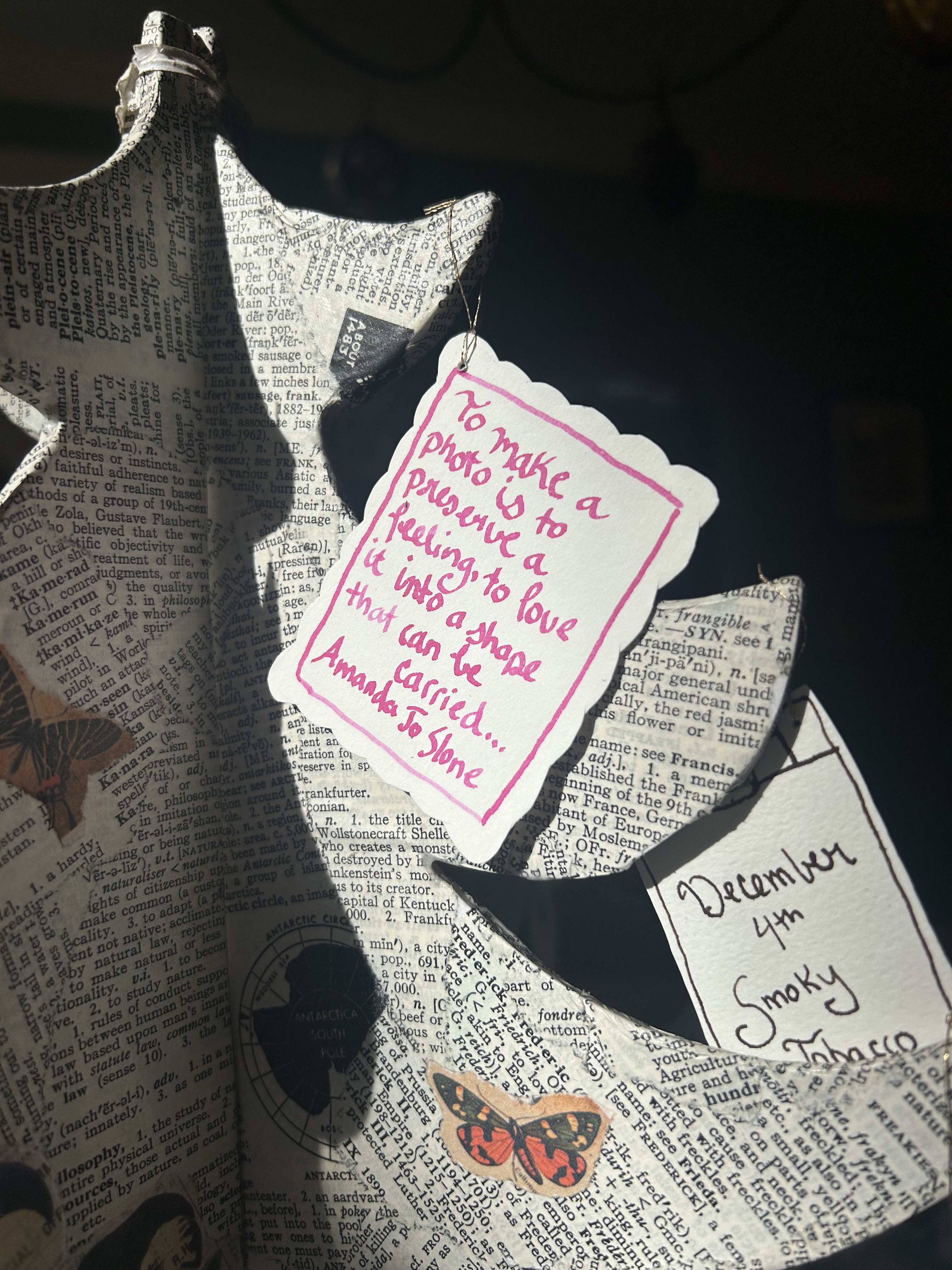
To make a photo is to preserve a feeling, to love it into a shape that can be carried…
-Amanda Jo Slone from Salvage, an essay in Troublesome Rising
One of the traditions at the Appalachian Writers Workshop that I love is the participant readings in the afternoons where folks read short pieces of their work for everyone assembled. Maybe it’s work that’s never been shared before, maybe it’s the very first time someone has ever shared their work out loud. There is great vulnerability and courage at these readings, and often revelation. For a number of years now, the readings have been facilitated with compassion and expertise by Amanda Jo Slone. Kind, funny and clear, she keeps everyone on track and on time- and let me tell you, that’s not an easy thing to do. She sets everyone at ease and makes it easy for people to take risks.
Amanda Jo is a gifted educator and writer who works to lift all boats through her work at University of Pikeville and her research project The Appalachian Way, which I hope you will check out.
The line on the ornament is from an essay she wrote for Troublesome Rising about the work of salvaging artifacts and archives from the 2022 flood in Eastern Kentucky.
Diamine Ink color Mittens. The older I get, the more I like pink.
My Advent Tree this year is dedicated to my writer friends and teachers. I am so grateful for all the light you shine in the darkness.
An Apology: I am behind on my Advent tree posts, the last week of school before the holiday break has pretty much done me in, but I aim to catch up in the next few days.
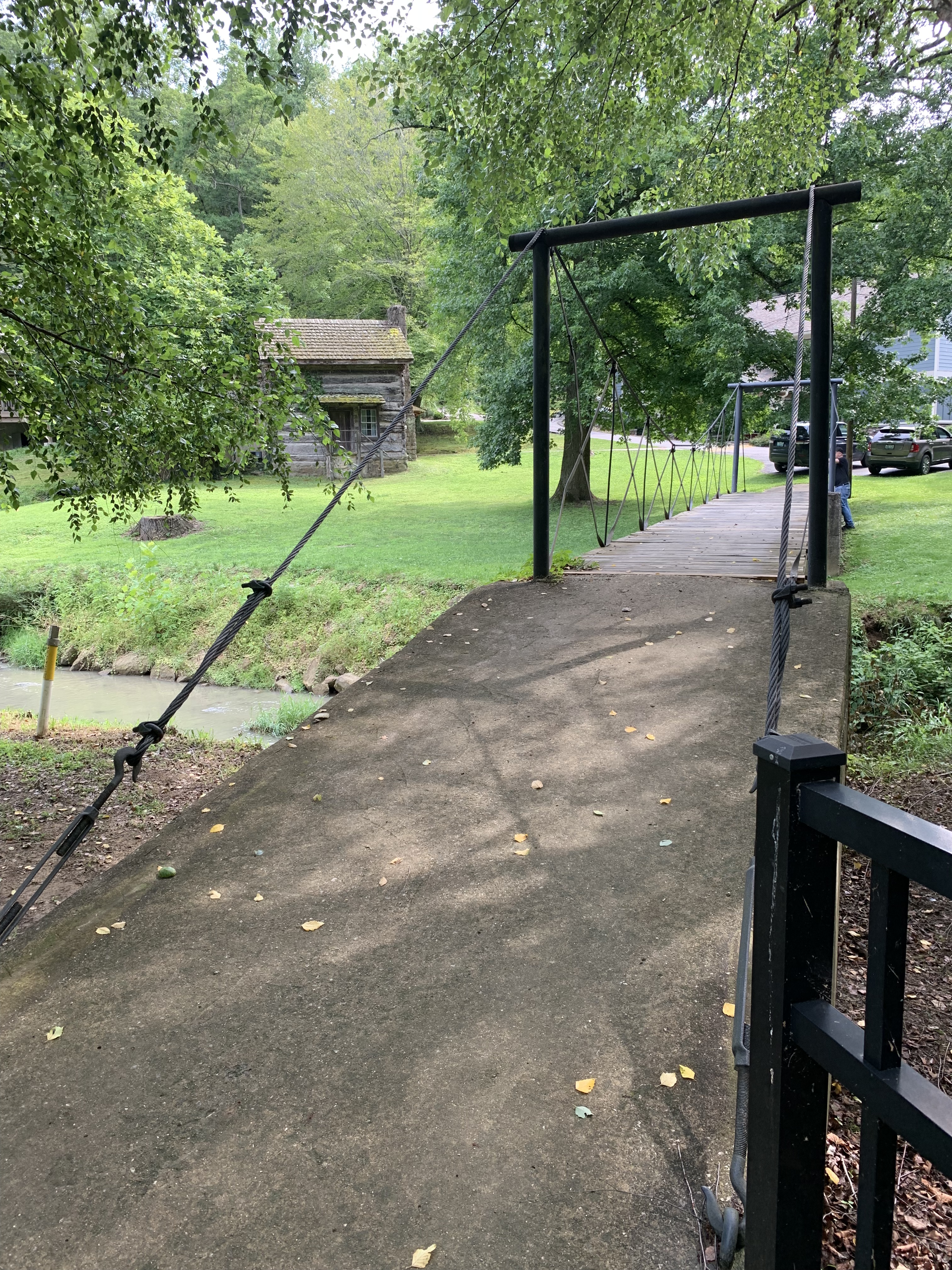
The Bridge over Troublesome Creek and Uncle Sol’s Cabin.
Most summers for the last twelve years you can find me at the Appalachian Writer’s Workshop the last week of July at the Hindman Settlement School on the banks of Troublesome Creek. Like a migrating bird, I cannot help but land at that same place at that same time. I was not born in Appalachia, but I’ve had many rebirths there. As a teenager, long ago, I fell in love with its music, which led me to its literature, then its history, its landscape and its people. I’ve managed to find work there as a teaching artist through the Kentucky Arts Council for months at time in years past, giving me time to learn, time to explore. We often speak of a chosen family, well Appalachia is my chosen home and the fierce, hilarious and talented people at Hindman are part of my family.
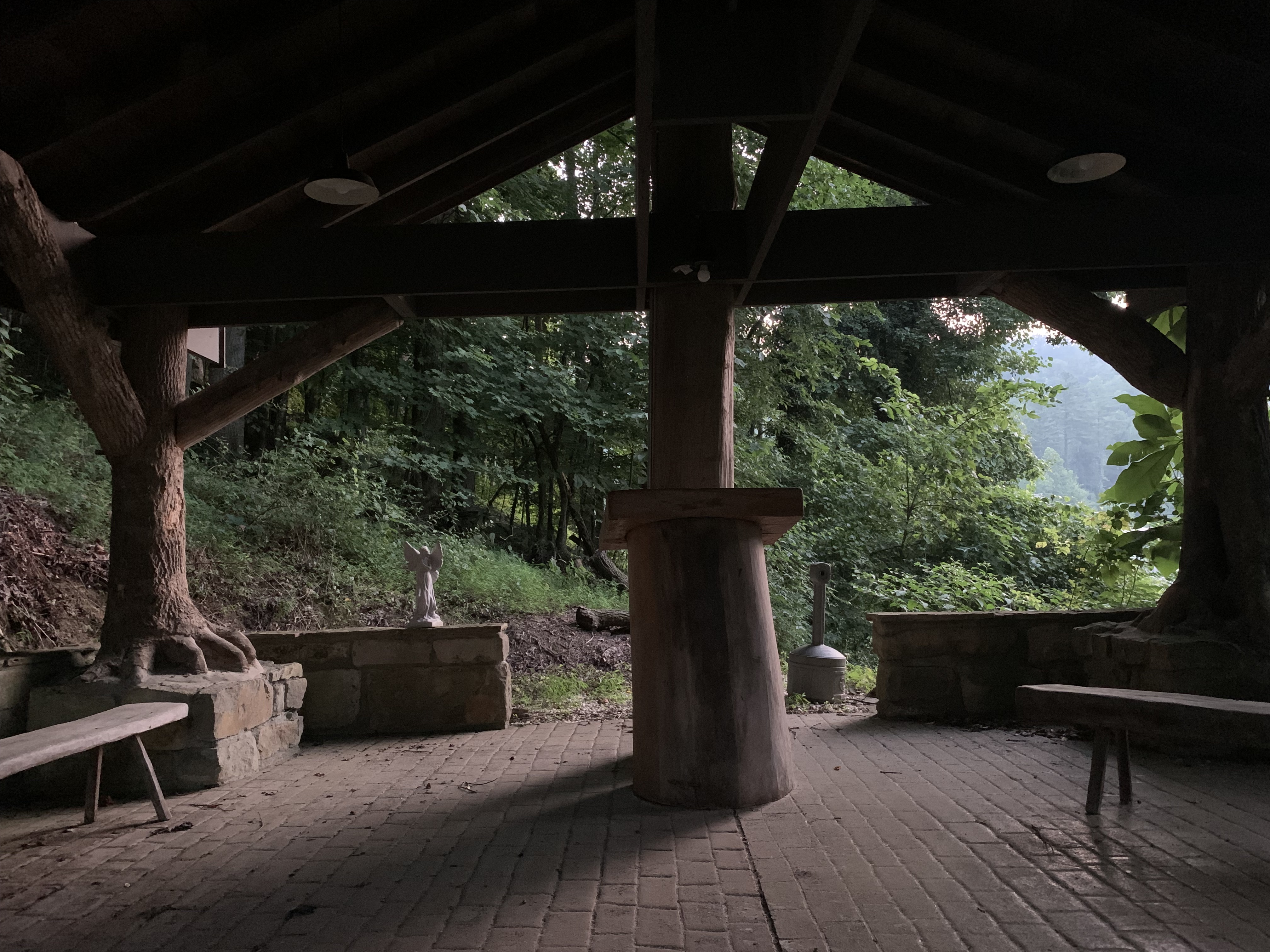
The Chapel near the graves of James Still and Elizabeth Watts.
The Hindman Settlement School was founded in 1902 by May Stone and Katherine Pettit, educators who were invited by Uncle Sol Evridge to build a school on his land for the benefit of his young ones and his community. There were no real roads, the creeks and streams were your highways. There were few schools and they were far away, hard to get to. This was a truth all over Appalachia. The hills and mountains rise fast and steep, there isn’t much bottomland to build on or to farm. Farmers joked that they scrape their noses on the rocks as they plant their uphill farms. Uncle Sol had a vision- To make a better life for his descendants. He walked more than 100 miles to mail a transcribed letter to Katherine Pettit and May Stone to convince them to start the School. And they came. With the help and support of the people in the community and with help from outside donors, they were able to build a school with houses for boarders, barns for livestock, gardens to grow their own food. They built right beside Uncle Sol’s Cabin which still stands today- a one room log house built sometime in the late 1700’s or early 1800’s.
The annual reading of The Brier Sermon by Jim Wayne Miler.
The School has come a long way since it began. No longer a boarding school, it serves Knott County and beyond through its dyslexia programs, the teaching of traditional folk arts, its burgeoning foodways program that is bringing small farming back into the region and it has been the center of Appalachian literature almost from the beginning. Kentucky treasures Harriet Arnow, Albert Stewart, Jim Wayne Miller and James Still began the annual writers workshop. James Still is buried on the hillside by the Chapel. Writers gather every summer and at times throughout the year to work on their craft, soak up fellowship and to teach each other.
There’s a lot of porch sitting too.
It’s a gorgeous place, a sacred place. Generations of people have made it so. When you are there, you feel that anything is possible and what you have to say matters. When you cross the bridge over Troublesome Creek, you are home.
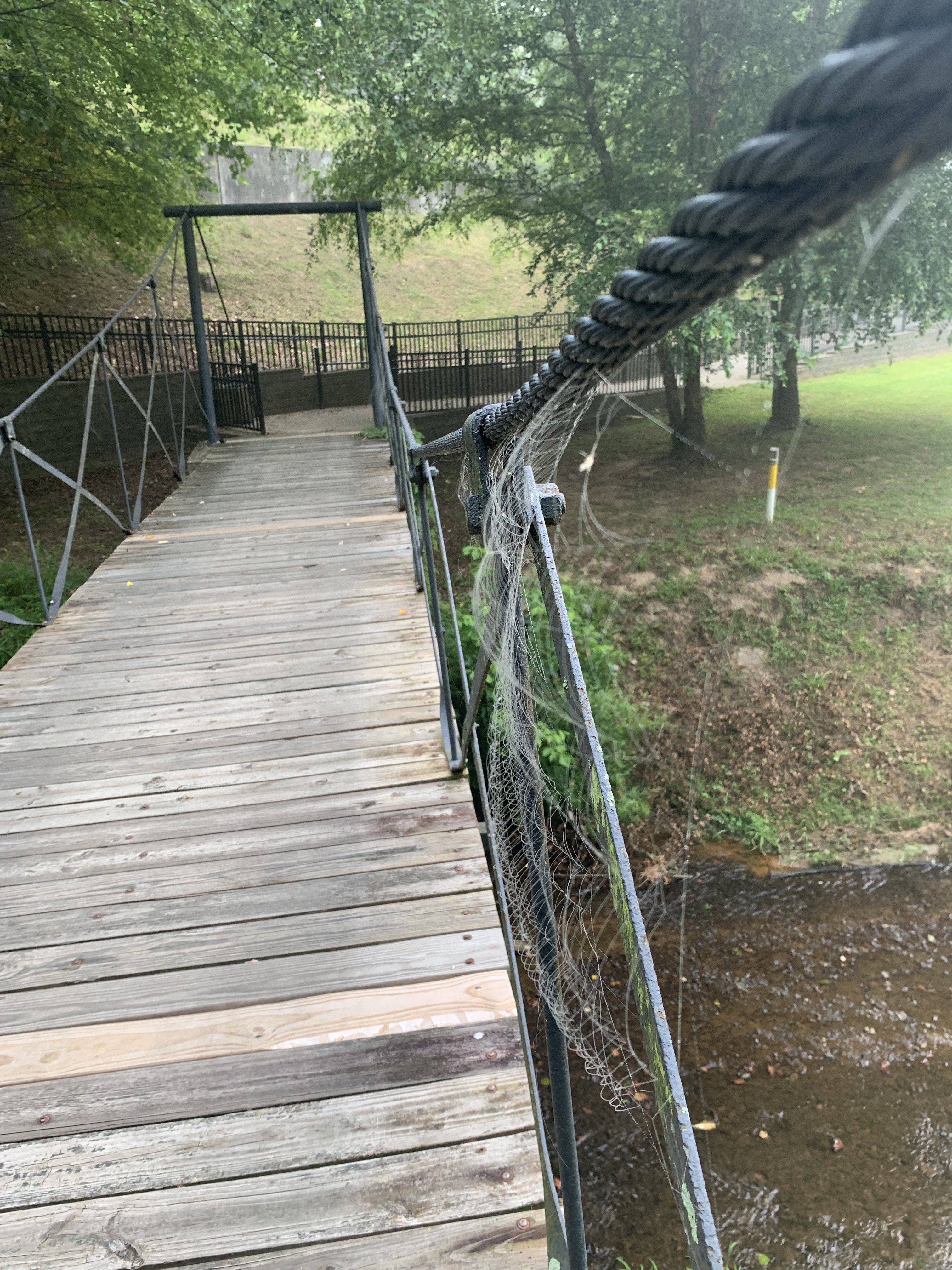
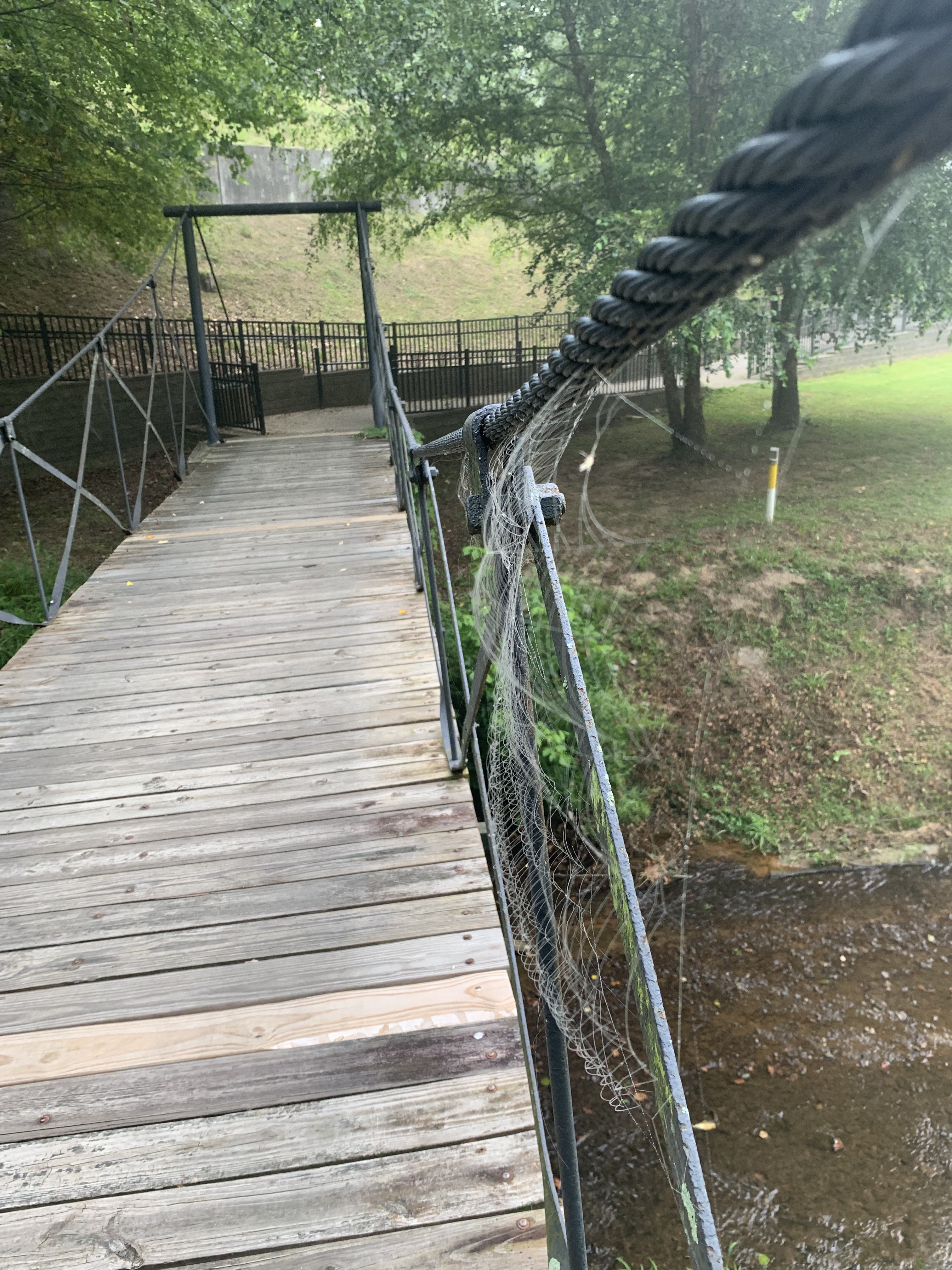
There are fresh webs every morning on the much loved footbridge we cross to our classes.
Troublesome Creek. It’s a long long creek, with a couple of branches that meet in downtown Hindman, the county seat with one traffic light close to the school. It eventually flows into the North Fork of the Kentucky River and then on into the Ohio. It’s just a little creek. Sometimes the creek goes dry even. Sometimes it rises fiercely and escapes its steep banks. You can tell it’s a troublesome creek by those steep banks, cut by erosion which is a longtime problem in Appalachia. Logging and mountaintop removal have destabilized the area, making it prone to flash floods. They are a common occurrence, part of life. People know how to live with them, at least they thought they did.
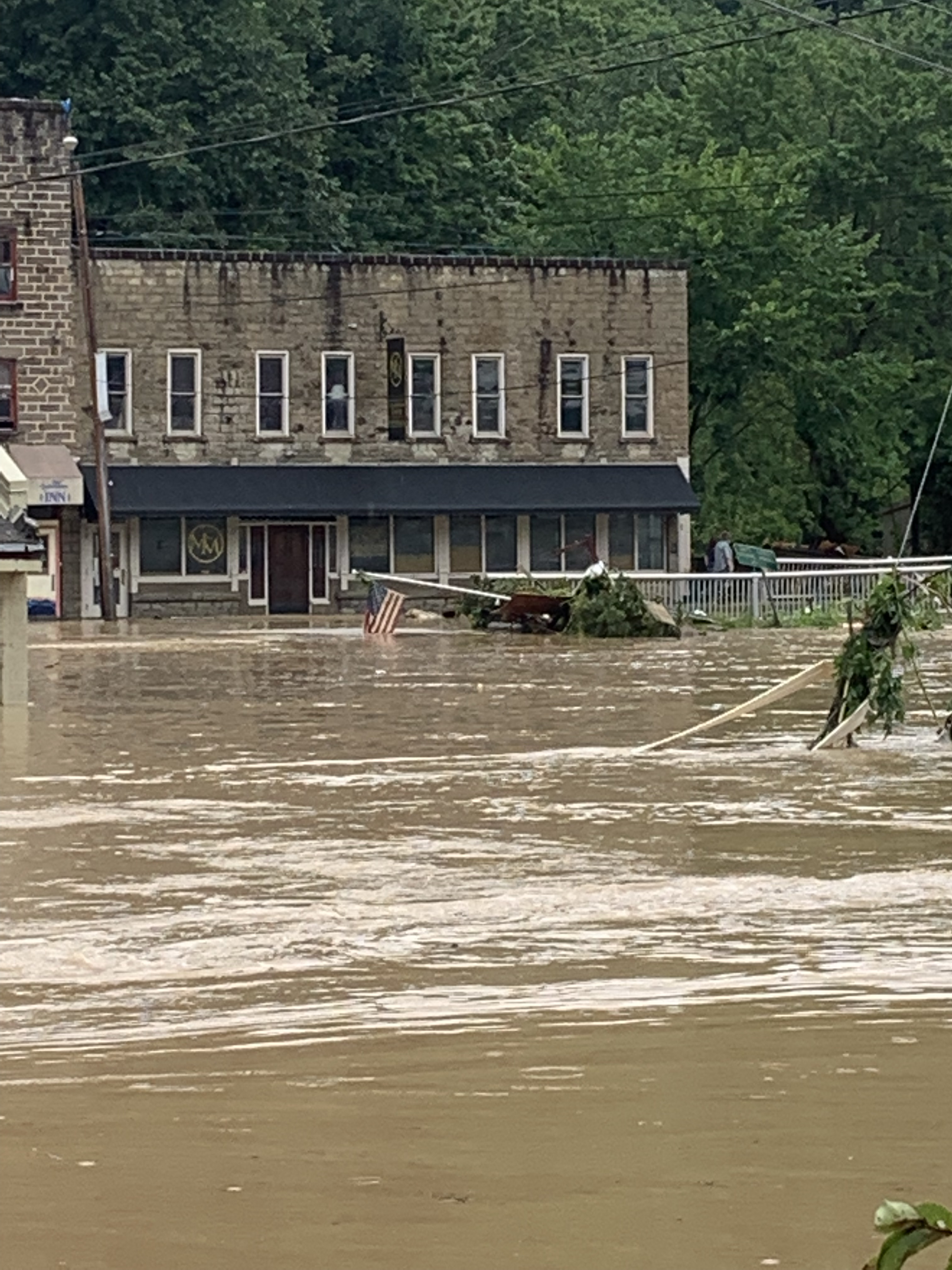
July 28th, I was at the Appalachian Writer’s workshop when the flood came. We were halfway through our blessed week. It had rained a lot and we could see that Troublesome was rising a bit, one foot, two feet, well within its banks. Wednesday was a great day- classes, communal meals, evening faculty readings and a trivia game night. Alerts for flash floods came across our phones, you know, the ones we all have learned to disregard. But that afternoon I told my roommate that I thought she should move her car away from the creek side of the main building. Mine was already on a higher spot. Really? She said. Yeah. Just in case. So she did, finding one last spot by mine. It rained hard all evening through our programs and socializing. It had been such a great day, I had trouble falling asleep. It was midnight when I did. At about 2:30 there was loud knocking and urgent voices, something about moving cars if they were on the low side. I stumbled to the hall, heard them say that Troublesome was rising fast. I went to the bathroom and flicked on the light, only there was no light. The electricity was gone. There was this roaring sound I couldn’t place- I shone my phone light out the bathroom window and could see that the usually bone dry little channel beside our residence, called Stucky House, was a white water torrent of water pouring down from the hillsides into Troublesome. DO something, do something. I started filling all the empty gallon containers in the kitchen from the tap in case we’d soon be without safe water. I filled the bathtub. It was all I could think to do.
The rain pounded, lightning flashed. More and more people were waking up, some heading to their cars. Josh Mullins, Hindman program director was soaked, the other Hindman staff too- all going to and fro trying to make sure that folks in the lower apartments were out. Former Kentucky Poet Laureate George Ella Lyon was in one of those apartments with poet Nickole Brown who had a hunch the world was about to explode. She didn’t go to sleep, but packed up her things at midnight and kept watch over the creek. It started rising so rapidly that by the time she alerted George Ella and helped her pack, water was coming through their door. They landed up at Stuckey, which became the refuge for all the Hindman folks in precarious lodgings. I grabbed my keys and moved my car even further up- driving up the little road that wends its way up past Stucky to the highest house on campus, others followed. People were crying, some had already lost their cars, their trucks, Tamela’s brand new dream BMX motorcycle- they had moved too late. That little tiny creek had risen impossibly fast, higher than anyone had ever seen. Some people stayed inside the living room together, some in their rooms, some on the front porch waiting for the glimpse of the creek that the lightning would give us. It’s over the bridge now, no way out or in. Josh and his team were down in the MIke Mullins Center, trying to pull things to safety from the downstairs offices- the computers, the archives. Josh could see that the creek was up against the new plate glass windows. He was thankful they had put in steel doors when suddenly the creek busted them wide open and all of Troublesome poured in. They got upstairs safely and out the second floor exit.
Emergency lights in Stucky gave us some dim light, there were some emergency lights on the outside of the Mullins Building. There were four white domestic ducks trying to get into a door, a window, anything. They moved as a frantic little group, they had been washed out of the home. There was an overpowering smell of gasoline, underground tanks had been ruptured and the creek was full of gas and propane and oil. It smelled like it could catch fire at any moment.
There was one member of the Hindman staff unaccounted for. Corey, his wife and three young daughters, lived across the creek in a sweet little house. The last anyone had heard, they were trying to get to a neighbor higher up, but they didn’t seem to be home. Their home was flooded and Corey’s wife had fallen and had broken her leg. Then we heard nothing. Phones weren’t working, cell towers were down. All night we huddled on the porch or in the living room, unable to believe what we were seeing. Unable to do anything to help. About 40 people, three dogs and two cats had found refuge at Stucky.
When the sky finally began to lighten at about 6:30, I grabbed my umbrella and walked over to the chapel with my friends Tia Jensen and Carter Sickels to see what we could see. From the chapel by the graves of James Still and Elizabeth Watts, you can see down to the creek, the health department and across to downtown Hindman. This is what we saw-
Under that Health Department building there is a parking lot besides which is Troublesome Creek. Then it pans over to the town of Hindman, the taller white building is the county courthouse.
Uncle Sol’s Cabin looking across to the Knott County Library and Opportunity Center. The water had receded about 5 or 6 feet when I took this.From the porch of the gathering place looking over to the library.
It was about 7am when I saw Corey walk up the hill to his colleagues. He was soaked and muddy, but smiling. Thank god. They all burst into tears and hugged him over and over. ‘I thought you were dead, I thought you were dead.’ They were all safe, but had lost their house, their cars. Corey’s wife needed medical attention badly. He was trying to get her to a hospital, was looking for a vehicle and hoped there was a way to get through the roads.
The water dropped quickly- faster than I thought possible. In a few hours it had dropped 10 feet or more. I felt sure it rose over 20 feet that night, later measurements showed this was correct.
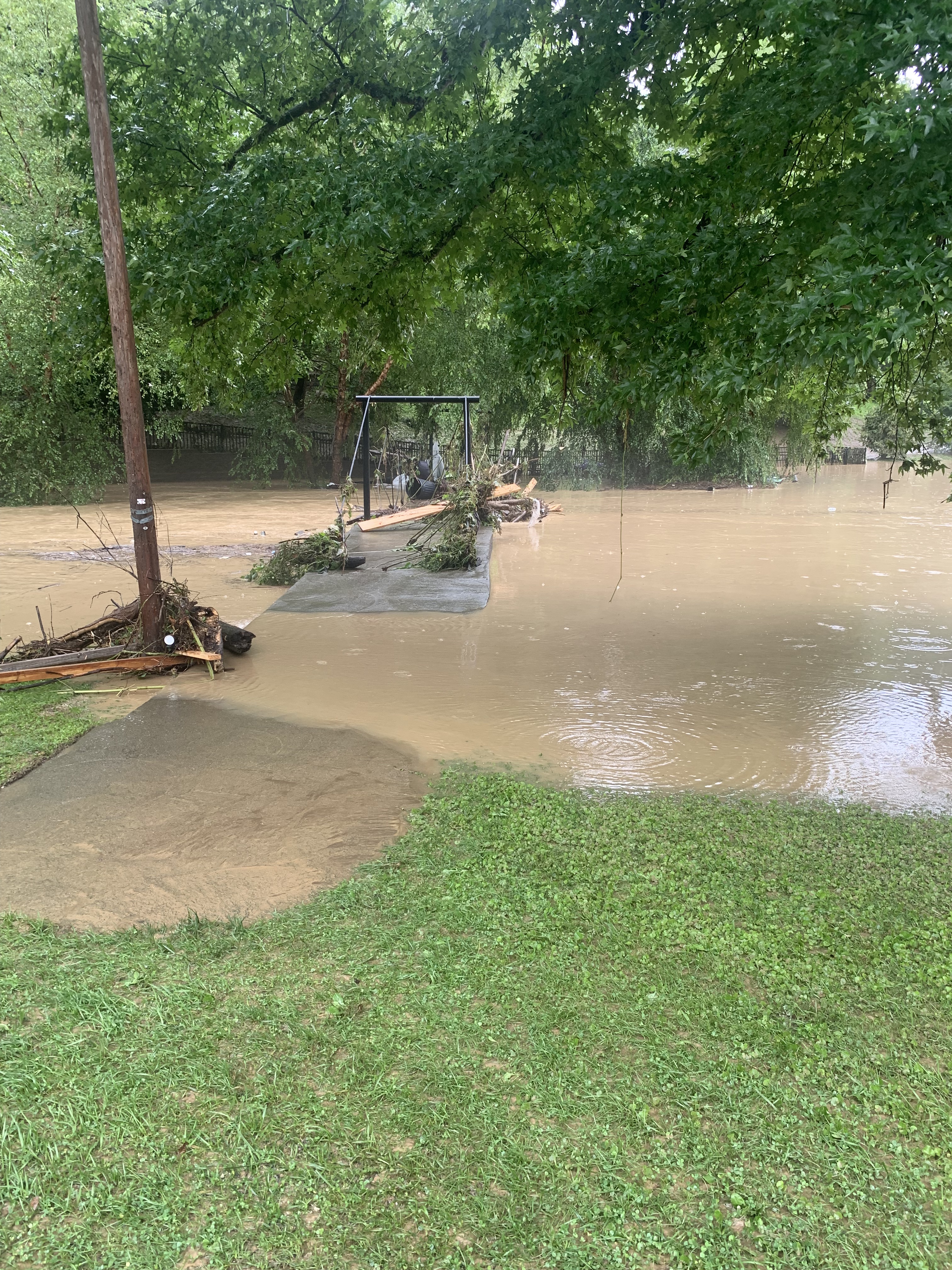
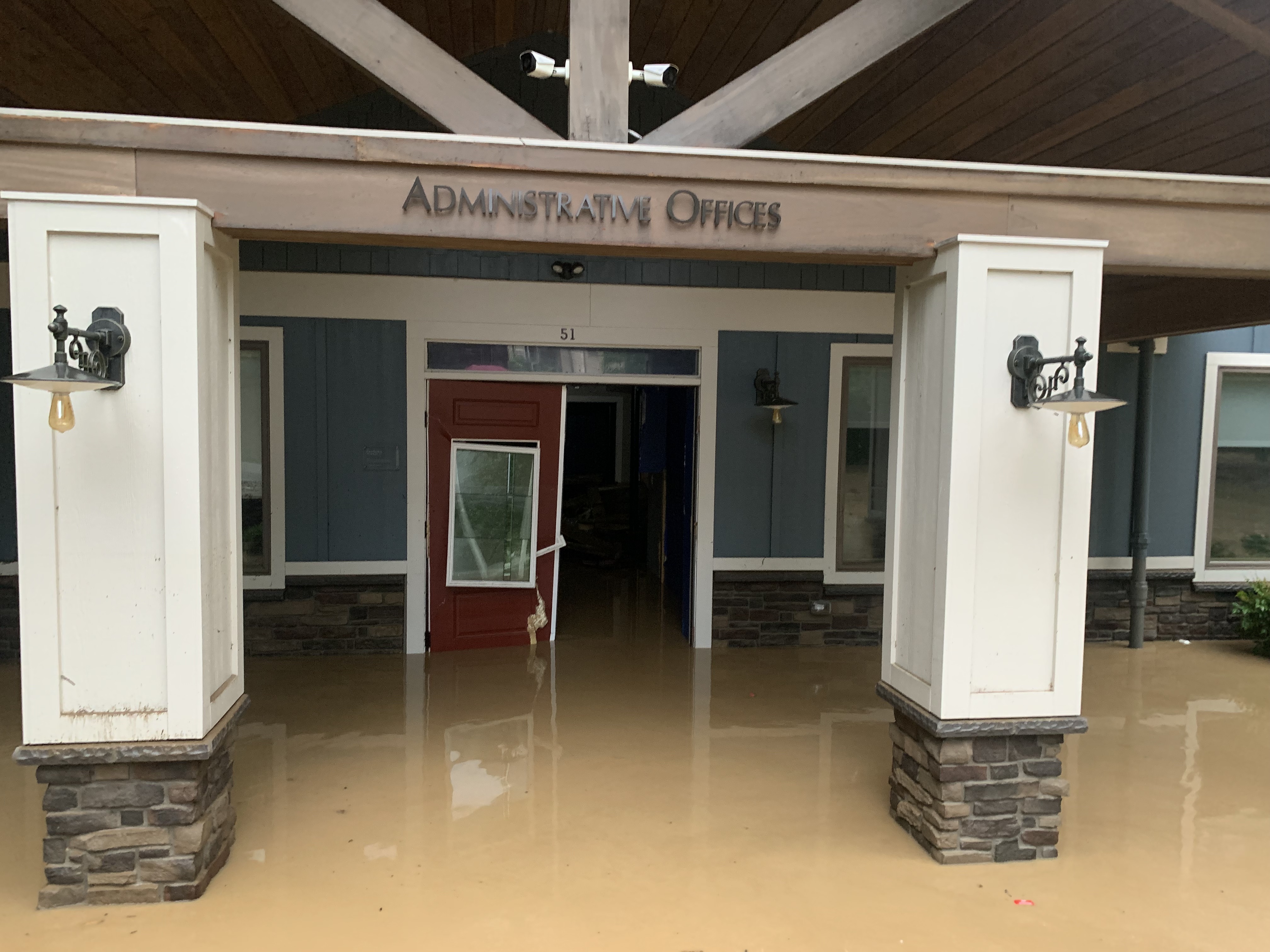
The footbridge over Troublesome after the water had dropped about 12 feet.The doors to the office busted open. The water reached to the top of the doors at its peak.
Taken from the bridge going to the main road into town after the waters had receded. The water had reached to the top of those doors.
Downtown Hindman. The waters had reached into the second floors.
All of us were numb, in shock really. Some cried, others figured out where to stand to get cell service to call their insurance agents. The smell in the air was noxious- some gaseous bi-product that no one should be breathing. No one knew what to do. We workshop folks knew we were going to be in the way- there was no safe water, no electricity, food was quickly going to be a problem. We knew we had to leave, though we could get no information about what roads were closed, what was open. More rains were forecast and who knew if we would be cut off again. There was a window for leaving and we just hoped for the best. People who had lost their cars were taken home by those who still had them. It took all of us a long time to navigate the way out- turning back when a road was washed out, finding another way.
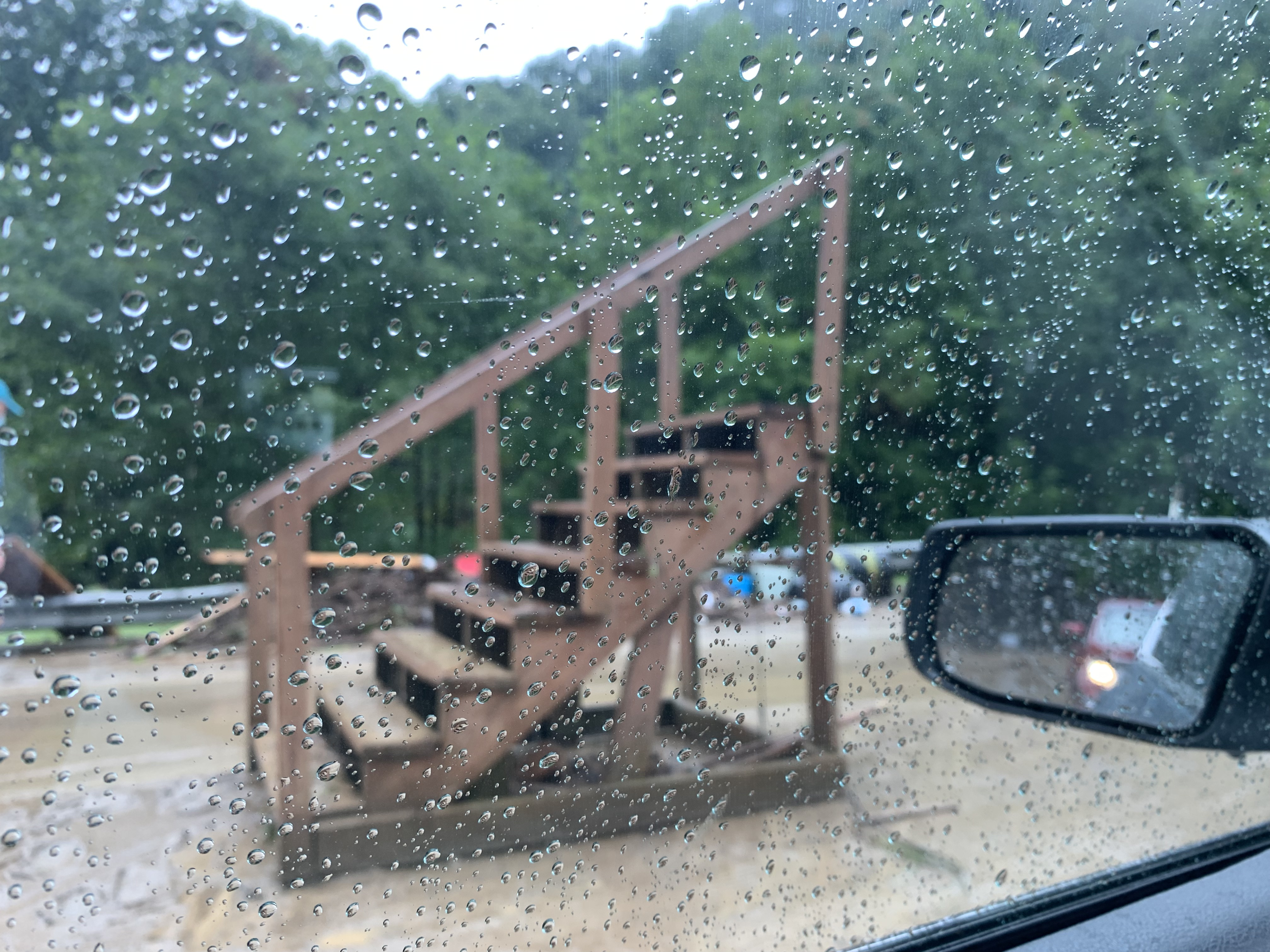
I drove around someone’s home smeared all over the road. It went from life to litter in an hour.
Our part of Troublesome creek rose like that in the middle of the night, in the dark. What is hard to comprehend is that ALL creeks and streams rose like that across 12-13 counties. It’s unimaginable. Truly. So many homes lie alongside the creeks and rivers- there is nowhere else to build. So many communities nestled down in the hollers were scrubbed out by the roaring waters.
We were lucky, us workshop folks. We had homes that were safe and sound, waiting for us on higher ground. Many thousands did not, having now only the clothes they were wearing. And they lost not only their homes, but their neighborhoods, their roads, bridges, grocery stores, churches, businesses, schools. Outside looking in, you’d say they lost their communities, but you’d be wrong. Appalachian people are uncommonly resourceful, resilient and loyal- That is what a Hillbilly is in reality. They’ve had to be. They’ve never been able to count on outside help, only outside exploitation. So they help themselves and each other. I do not discount the heroic and swift efforts of the National Guard who were able to pull over 700 people off their rooftops, but it was neighbors who saved thousands more- wading chest deep into dark houses to get their older or disabled friends to safety, who paddled up in kayaks, canoes, john boats, rafts to get their neighbors off their roofs, who tied each other to trees to keep from getting swept away. It’s neighbors who are now mucking out each other’s house, building their debris piles, sharing their food, water, clothing, anything they have. The restoration work will take years, and it may well happen again. Hydrologists have estimated that water runoff in the area is now 1000 times worse thanks to strip mining and mountaintop removal, and the heavier rains of climate change make this a real and terrible threat.
The very morning that Hindman Settlement School woke to its own loss, they pivoted to become a shelter for others, a center for supplies. They scrambled to find grills and found a way to provide three hot meals a day to the community, even as they were trying to save their collection of instruments and their precious archives, a legacy of Appalachian culture. All over Appalachia, this is happening- people coming together to help each other, a true Water Communion, an ingathering of love and care.
Those of us standing on higher ground have the opportunity of joining this ingathering, of saying “We are your neighbors and we want to help”. That so many people are doing just this, gives me hope. But it’s been over a month now and folks are starting to forget, the news cycle has roared on. I’m writing this now to remind myself, and anyone who will read it, that the flood is not over. Many are living in tents on contaminated ground, others are living in FEMA trailers parked on unreclaimed strip jobs, roasting in the sun, no shade, no way into town, no schools for the children who have nothing else either. It’s time to build schools, homes, businesses. It’s time to build bridges.
Look at the amazing folks at Eastern KY Mutual Aid Group who brilliantly get money and needed goods directly into the hands of people who need help. It’s neighbors helping Neighbors, but they can use the help of neighbors farther afield. Check out their Facebook Group: https://www.facebook.com/groups/2557126217948530
Adriana Trigiani was the keynote speaker for the Appalachian Writer’s Workshop at Hindman Settlement School this year. On Zoom she was powerful, intimate, dynamic, funny, full of respect and truth. I’d want her in my corner when I’m on the ropes. She’d find a way to get me up and fighting again.
Here’s the struggle- for one almost whole week I had the great gift of being at the writer’s workshop there at Hindman where all my needs were met- really delicious food (dessert with every meal!), a lovely room, inspiring and generous teachers, trails to explore, quiet places to sit and think, a beautiful campus rich with history, and a community of old and new friends all working to shine some light in this world. All week we were surrounded by beauty and art and heritage. We were in a place that has a long history of lifting people up. It is sacred ground, truly. And now I’m home.
The foot bridge over Troublesome Creek at Hindman Settlement School in Knott County Kentucky. That’s Uncle Sol’s cabin in the distance. It was his desire to educate his children that was the catalyst for the school.
Last year I attended the workshop online along with everyone else. Hindman did a great job with it, but we all felt the loss. At home, I tried hard to make the time sacred and for moments I could fool myself that I was there, lose myself in the readings, the discussions, the sharing. Just hearing everyone’s voice was enough to keep me afloat. But there was always the moment of hollowness when the Zoom screen disappeared and there I was sitting alone at home about 30 seconds away from having to take care of something or someone. I remember sitting there feeling like all the water just drained out of the tub. It was heavy work hauling myself out and putting myself into motion again. I do not think I was alone in feeling this. I know I wasn’t. And I know that those who attended online again this year felt it again, even more so. It just hurts.
Former Kentucky Poet Laureate George Ella Lyon, a most remarkable writer and teacher. She looks kind of mean in this photo but it simply isn’t so. This is what the set-up looked like from our classroom on campus this year.
Lucky, so lucky to be there this year. It was an oasis I badly needed, an oasis I hated to leave. The degree to which I am mourning it shocks me- do I really dislike my life so much? The one I made all by myself over all these years? Of course not. But there are so many things I dread and even despise about what everyone agrees is the necessary business of life. Not so long ago I wrote in my journal that as I lay dying (someday far far from now) that I will toss bouquets to heaven, rejoicing that I will no longer have to fill out financial aid forms, file taxes, pay bills, navigate mortgage refinancing, fight property valuation increases, rob Peter to pay Paul. ‘Hallelujah!’ I will shout- or gasp, or whisper or maybe just think- ‘I can just be me again!’
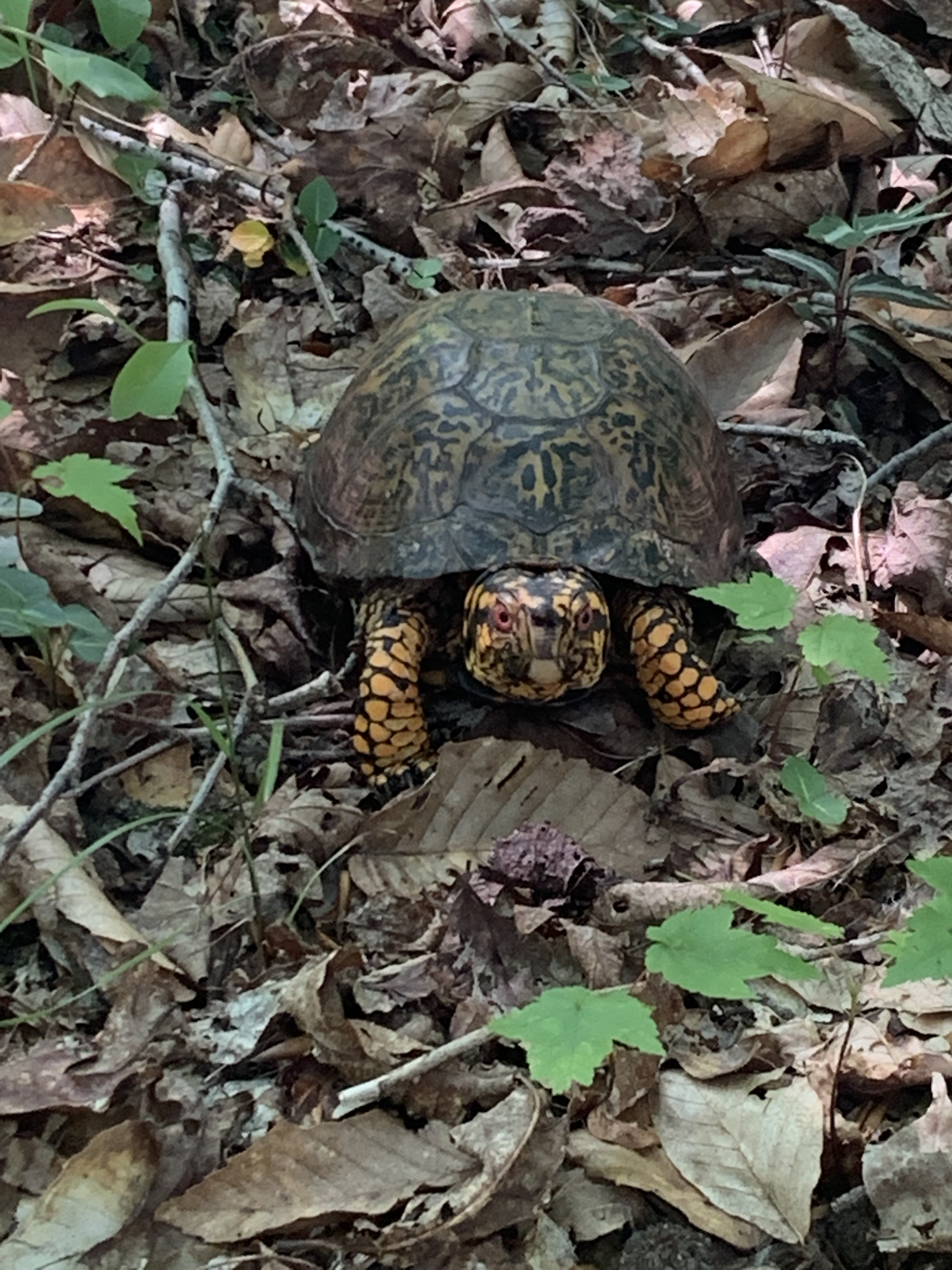
I always see turtles when I hike up on the trail behind the school. They always tell me the same thing: You already have everything you need.
That’s what it felt like this last week. I was just me. Not responsible for anyone else. I am amazed at how little I thought of my family, those I’ve lost, even my daughter who is everything to me. I forgot all week that I was a mother, a daughter, a teacher, an employee, a homeowner, all of it. I allowed myself to simply be. I didn’t have to justify the time I spent reading, writing, listening, making art, exploring or simply looking out into the distance for long periods of time. I mean justify it to myself because it’s mostly me looking over my own shoulder saying ‘don’t forget you have to… remember to… it’s been a long time since you… you really ought to- clean, cook, shop, weed whack, visit, call, pay, plan, work your two jobs since that is what pays you.’
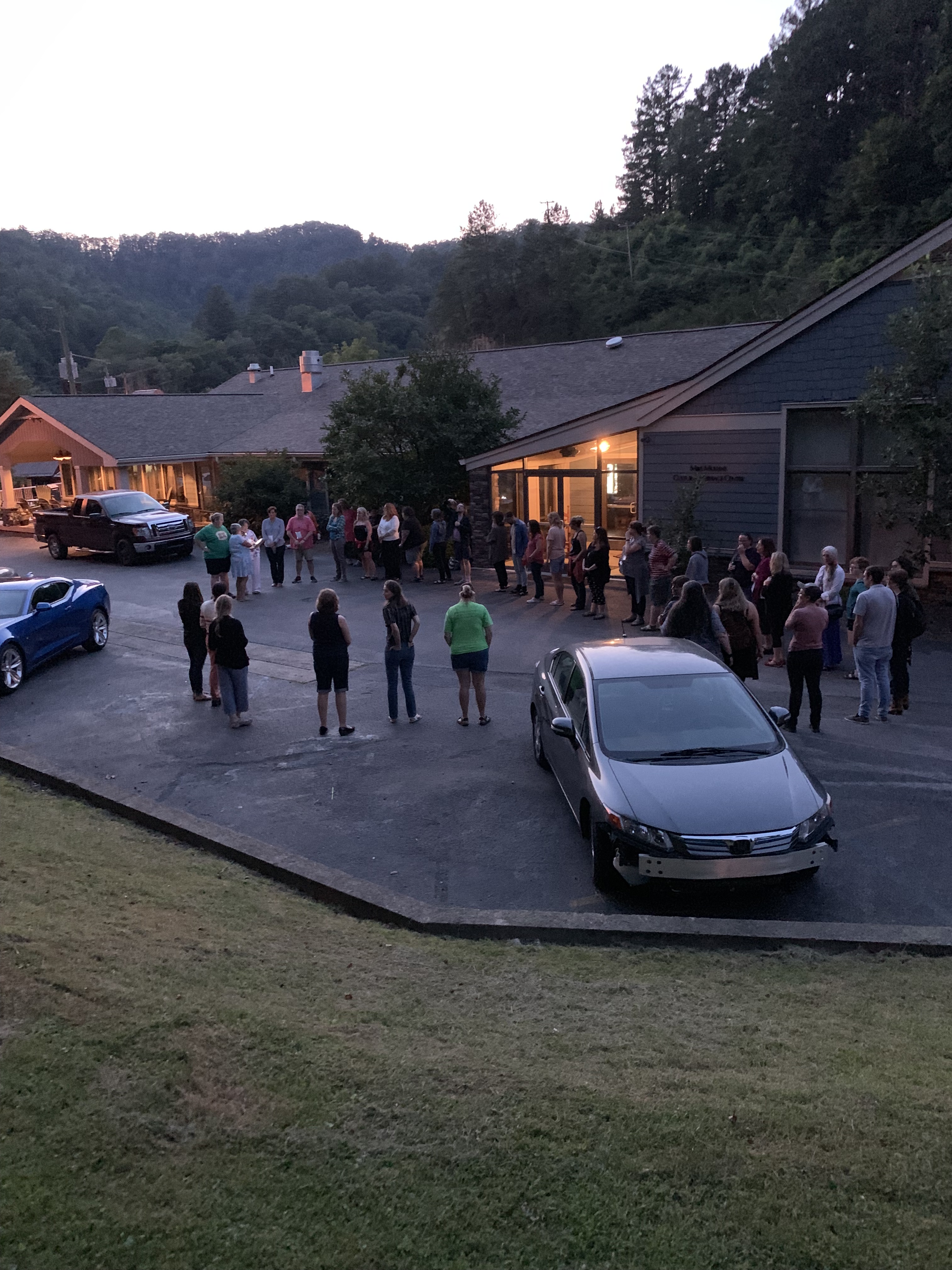
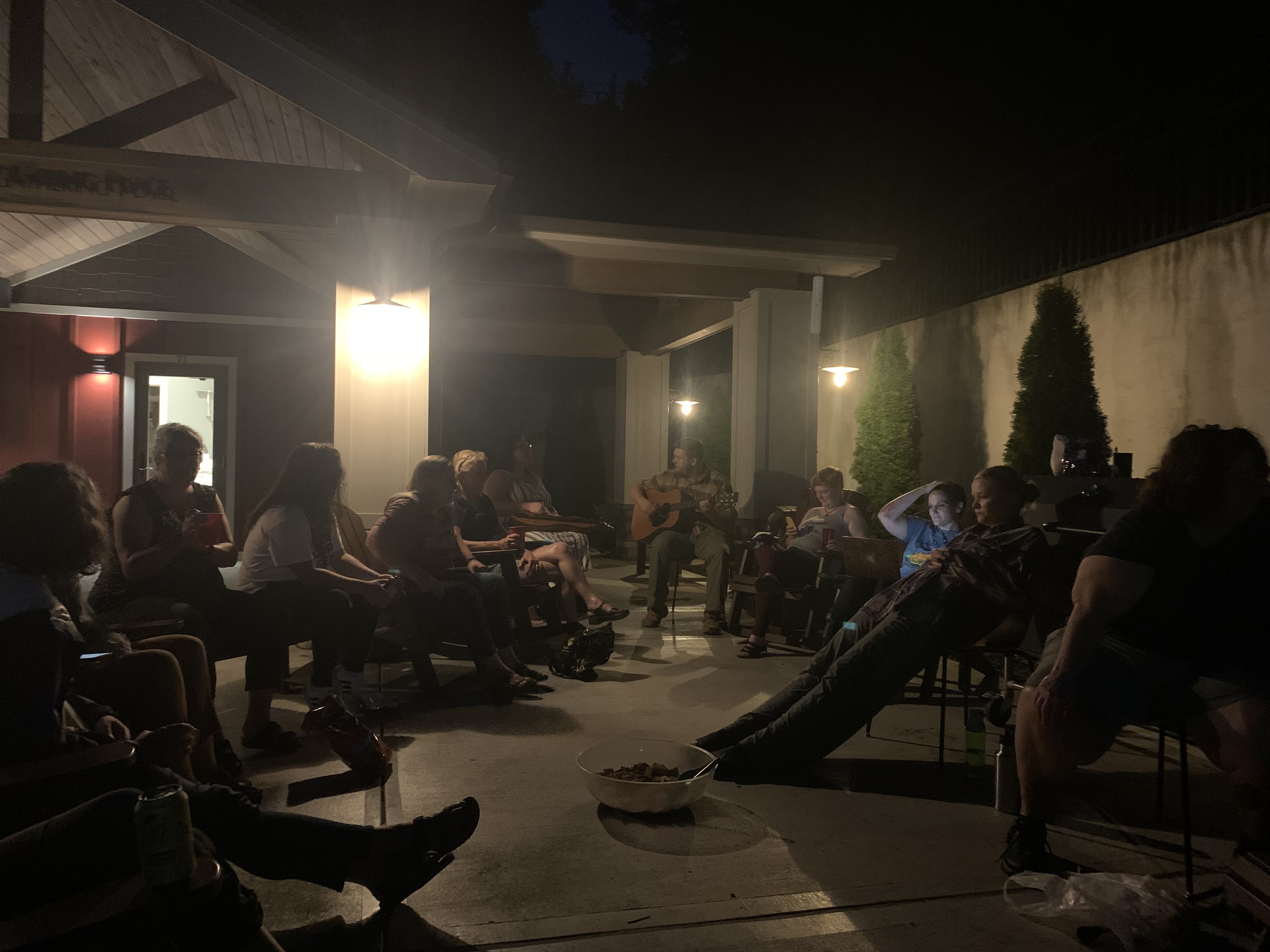
Circle time with new and old friends in the evenings was a great joy after the last 18 months.
I am not alone or unique. It is what many experienced at the workshop. This glorious week and then we go home floating high with what we have learned, experienced, created. And there are our lives waiting for us to pick up the reins again. How do artists, writers, dreamers keep it all going? Those dear mothers of small children have an especially hard time because finding time to write feels like stealing time from your babies. Say what you want, that’s what it feels like and how can anything beautiful come from what is stolen? I remember well that precious, tender, terrible time. We talked about this in our last class with the remarkable George Ella Lyon who is a wonder and a gift. She walks us through our own mansions with an enormous keyring at her waist unlocking door after door for us, saying ‘here, did you know you have this room in your house? Now you can come in anytime.’ But on our last day, many of us were despondent- how on earth can I even find that room again once I get home?
Every morning, spiders webs magically appear on the bridge over Troublesome.
I have some thoughts on thresholds and doors you can close. When everything shut down in March 2020, we all went home. It was exciting at first, an adventure, something new. I require solitude, crave quiet. The busy-ness of traveling here and there, being split between my two jobs can be very wearing, so being at home really appealed to me. In some ways life was more peaceful, in other ways it was maddeningly loud inside my head. Suddenly there were no boundaries between work and home, between my two jobs, between my family and my writing life. No thresholds to cross, no journeys to help reset and refocus for the next task at hand. There were no doors to close to keep the outside from coming in and I felt I had to be reachable at all times. Tethered to the computer screen, I worked to figure out how to teach theater online, how to have Sunday school, how to keep children from feeling the way I did- unconnected, unreal, unimportant. Truly maddening.
Statue of boys sledding high on the hill in front of Preece House.
My office at home isn’t a room exactly, more like an odd-shaped hall at the top of the stairs leading to other rooms, a feng shui nightmare as energy hemorrhages from that space. It’s okay for business type stuff but not for the deep dive needed for writing. I fiddled with spaces all last year- found the best settings for my various zoom classes, rearranged furniture, created a writing space in my bedroom where I actually have a door to close. I designated different desks in the house for different endeavors. I have a ridiculous number of desks, perfect for someone who habitually takes on too much.
So here’s the current line-up:
The Business Desk: At the top of the stairs. It is an office type desk with filing cabinets that I bought at Big Lots ten years ago. It’s for businessy type things, including my work for school or the church.
The Letter Desk: Not six feet away is my childhood dresser desk, a Victorian affair with drawers and a desktop you lower to reveal cubbyholes. For letter writing and my international postcard obsession, for correspondence of any kind that involves paper and pen and the stamps that I love so much.
The Poetry Desk: A small cherry school type desk with a sloped top that I got in a neighborhood second-hand shop. It sits in a window dormer to the right of the Business Desk. It has been largely ignored these last couple of years but it is reasserting its importance.
Lap Desks: I have these two very old pressed cardboard lap desks that I got when I helped my cousin clean out an old relative’s house decades ago now. They have held up remarkably well. They travel out on the patio if it’s nice or beside the fireplace if it’s cold or in the armchair upstairs that looks out into the yard if I want to keep an eye out for the birds and the postman. This is where I do most of my journal and blog writing and my reading.
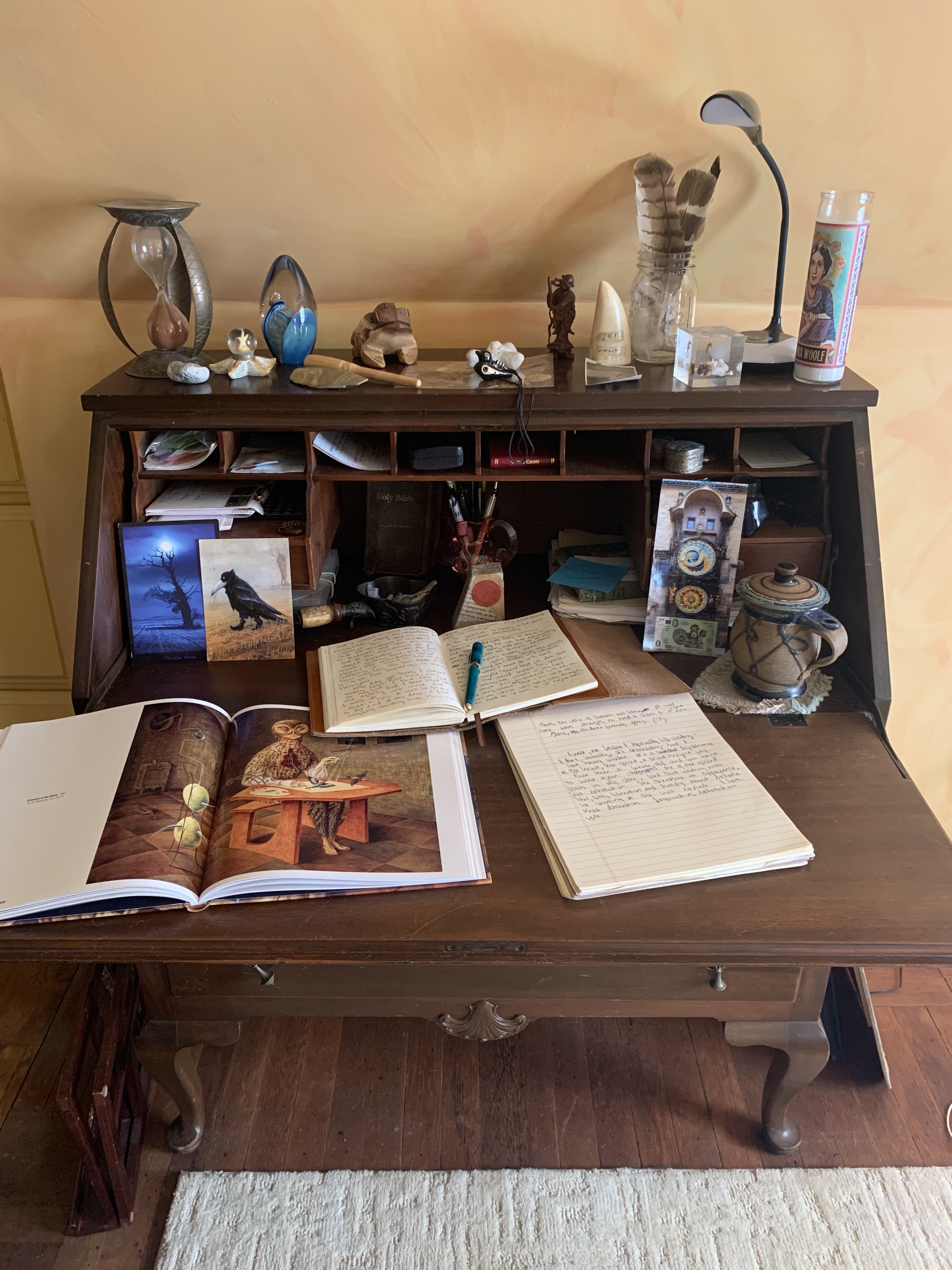
The Magic Desk: In my bedroom/meditation room with a door I can close, a gift from a family friend long ago. It’s an antique secretary desk with a drop front and cubbyholes, like the letter desk. This is where I work on The Tapestry Room, a historical fantasy novel for young readers. Here is the one place in the house I can close the door. If I mindfully cross the threshold into this room, say ‘I am a writer entering a sacred space’, the chatter in my head quiets down. I close the door, take the three steps down in to the room, play the music that is my touchstone and almost immediately the peacocks swish their tails and I can enter the world of the book.
The Magic Desk
By moving from desk to desk, I can change gears and officially set aside the thoughts that do not belong to that desk. It’s how I trick myself into focusing and mostly it works, helps keep my work separate and clear. It helps to make a little room for the private work of my soul. I write, not because I especially like writing, but because I love having written. It’s a lightening of the heart, the spirit, a secret bright joy. But then that feeling wears off and you have to write again. Patsy Kinser, one of the remarkable poets in my class, said that writing is her exhalation. She breathes in life, loss, love and exhales poetry. I love this. Inspiration, exhalation. Yes.
The Chapel up the hill by the burial places of writer James Still and teacher Elizabeth Watts.
In her keynote, Adriani (I feel we are on a first name basis now) told us to set our alarms two hours earlier to write, fresh from sleep, before the world starts making demands. She said to create a sacred space for writing, even if it’s just a corner of the kitchen table. A woman after my own heart, she advocates getting dedicated notebooks for projects- no writing the grocery list or the household chore to-do list in the novel notebook. She said ‘Love everybody, take care of everybody, but put yourself on that list too’. Over and over her message was: Don’t waste time, don’t kick that can down the road, you’re feeling pretty good right now- get it down. Don’t. Waste. Time.
On the last night, it’s a longtime tradition to read The Brier Sermon by Jim Wayne Miller, one of the founders of the Appalachian Writer’s Workshop. It’s about being born again to the birthright of Appalachian heritage. Everyone in the circle reads a part of it and joins in on the refrain “You Must be Born Again”. We ended this year by singing Will the Circle Be Unbroken, hoping that next year everyone will be together on campus.
Making time to write is very difficult, then actually writing is harder still. The world leans in hard telling us that what’s in our hearts and heads can wait, isn’t important, will never lead anywhere. That’s the voice of Death. It will come soon enough, no need to listen to it right now. Write. Glory.











 The Fox at Dawn